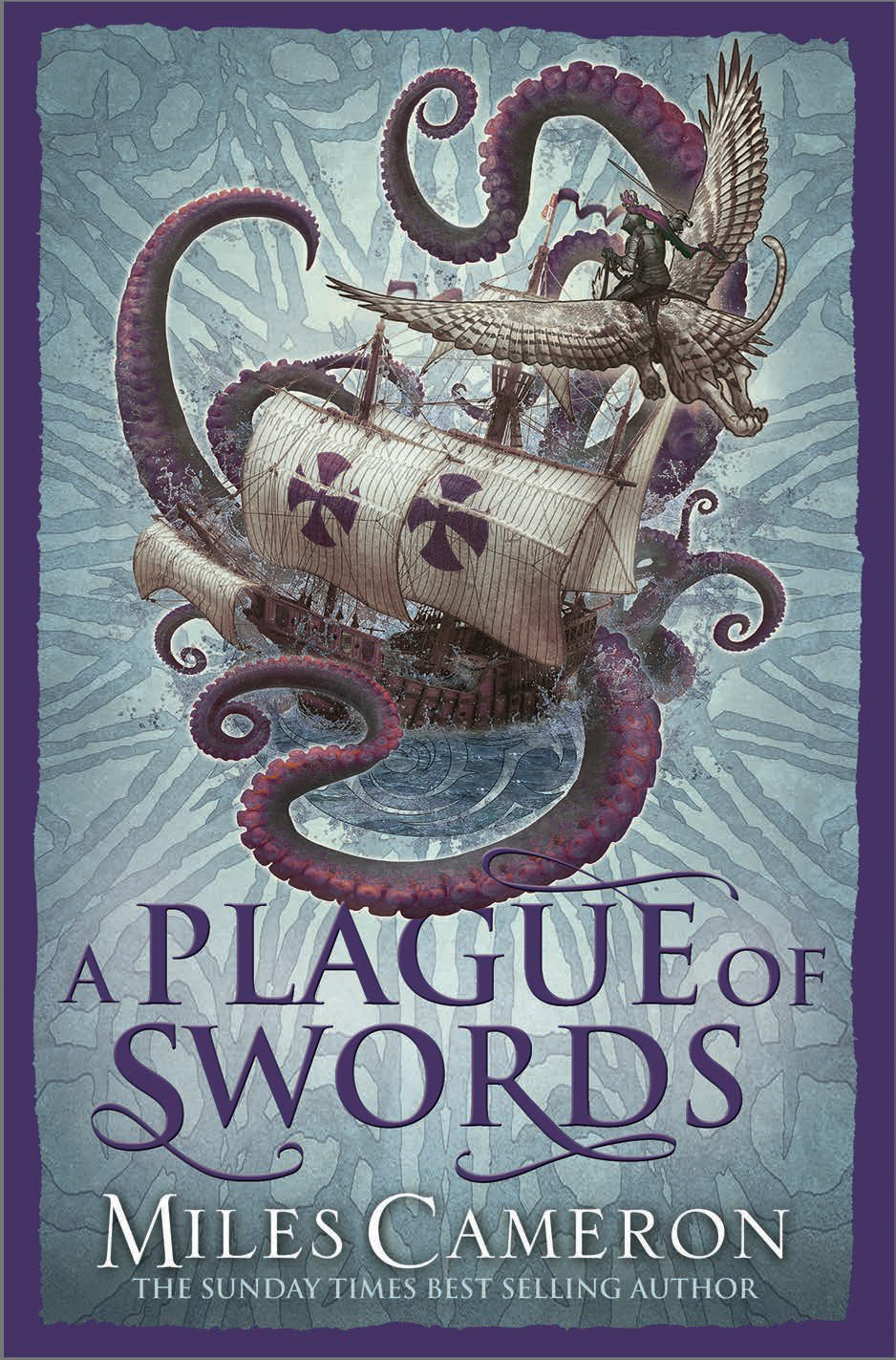
In a few days (October 25th, 2016) Plague of Swords will be out.
First, a word from the author. Many of you probably know this already, but when a book comes out, the author wrote it between twelve and eighteen months earlier. (Maybe more or less depending on various things. But with me, twelve to eighteen months). In fact, I completed Plague of Swords on August 4th of 2015. Then it went though an edit, a copy edit, page proofs, and a final read of the PDF of the final copy. There were covers to approve, and other goodies.
But really, yes, you could have read it a year ago in August. In fact, that’s when my Beta-readers saw it. And of course, I’m writing the last book in the series now; Fall of Dragons. Of course, that’s a working title, and it may not survive contact with the publisher. Just FYI, as of this afternoon when I left work to pick up my daughter and get her new pointe shoes, I was at 85K words and a little bit under half way done.

This is interesting (maybe only to me), because in the run up to publication date for Plague of Swords I get some media interest and some blogger interest and of course, it’s all about Plague of Swords.
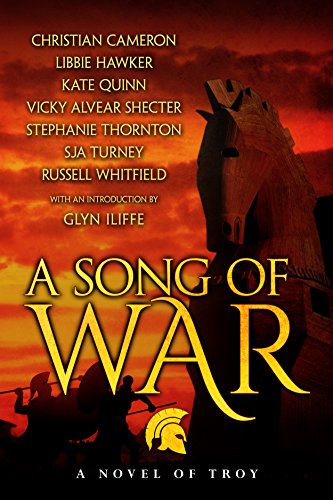
The thing is, I’ve written something like 500K words since I wrote Plague of Swords. I wrote Rage of Ares (Historical, Christian Cameron, out this month, 140K words) and I wrote ‘The Green Count (Historical, Christian Cameron, Chivalry or William Gold series, out in February, 125 K words) and I wrote a long Tom Swan story (Christian Cameron again, Tom Swans are ebook only, 40K words) and I wrote the Achilles Hector duel for the ‘Song of War’ anthology (almost 80K words, although it was cut to 40K) and, as mentioned above, I’ve written about 85K of Fall of Dragons. So when people ask questions about Plague of Swords, I’m tempted to go re-read it. Writing-wise, it was a long time ago.
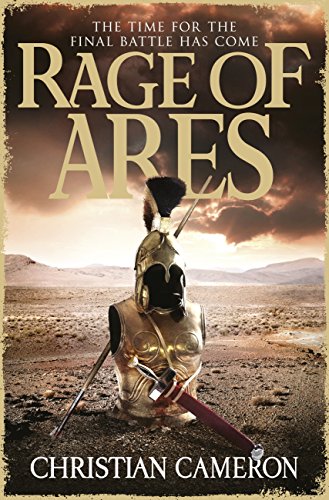
(And by the way, that’s MY panoply on the cover of Rage of Ares… my sword from Manning Imperial, my helmet from Manning Imperial but based on the original in the Walters in Baltimore, my superb thorakes from Jeffrey Hildebrandt at Royal Oak Armouries. Brag, brag.)
Tangentially, but still vaguely germain tot the title of the article, last month I went to Gollanzfest (#gollanzfest) in London and to ‘Fantasycon by the Sea’ (British Fantasy convention) marking the first and second ever public appearances by Miles Cameron, except for some book signings and launches at Bakka Phoenix in Toronto (which is, BTW, the finest Sci-Fi and Fantasy bookshop in the world. Period.). (#Bakkaphoenix. Watch out for me, I know what a hash tag is…). My intention here is to sidle up to the topic; bloggers and the press and fans (see, at the cons, you meet fans. Of course, I also WAS a fan; hugely. Wow, I met Alistair Reynolds. I love his books.Fan, fan…) Point — watch out, here it comes — the point is, people ask questions, and a lot of questions directed at me seem to be about writing history and writing fantasy and how much overlap there might be. Certainly I’ve touched on this before. But most of the fans I spoke to were also writers; they made me think of my work differently. So here goes.
How much ‘made up stuff from my head’ should there be in Fantasy?
Well, first, as much as you want. Seriously; these are my books, and I get to do whatever I want; in your books, you, too get to do whatever pleases you. But for me, as a reader, as a fan, and as a writer (no double standard here) I believe that whatever you do, it has to work. I don’t mean work as in ‘fiction.’ I assume anyone who wants to write can write decent fiction. I mean, the society, the magic, the weapons, and the horses and the air cars and what have you. They have to work. I listened it Elisabeth Bear (fan! fan!) give a great talk which I can synopsize as ‘Medieval cooking doesn’t work the way you think it does.’ In effect, what she said was that if you imagine a travelers’ inn where everyone eats stew from a huge iron pot, you probably don’t know enough about how medieval cookery works, or even what the huge iron cauldron is for. People who do know, and there are many in fandom (SCA, LARP, reenactment and online gaming have created some remarkably informed audiences) will mock you; worse, their suspension of disbelief will be jarred and they won’t keep reading.
No one needs a degree in Medieval History to accomplish this. Scott Lynch (fan! fan!) in his awesome Gentleman Bastards series, never seems to hit a wrong note. I’ll go out on a limb and say that he, like a number of other excellent authors I know, simply does not go into detail if the details might be wrong. It’s an excellent technique; you can find it in Tolkien, and he had ALL the degrees.
I’m very interested in combat and martial arts; and in strategy and tactics, and in logistics and castramentation (a word never before used in a blog) . I’m interested in a lot of other stuff, but let’s just stay with these things. I freely admit that when I’m writing fantasy, I WANT to tell you about how these things work, and how they work in war, even fantastical war. Mostly, I want to, because I know how they worked int he past, and I can make them work in a fantasy context. Out there in the genre, there are armies marching around (and even individuals) who don’t seem to know that horses die; need water, eat, fart, sleep, get cold, are dumb as posts, munch grass endlessly, fight you to get at grape vines on walls, will eat flowers… so much to know. So much that can make a horse come alive, even if the reader has never seen a horse. So much about food and water that can explain why and how an army is trapped; why armies sometimes have to fight even though odds are long, and appear foolish; or why a few well fed people might defeat a horde of starving people. I agree that an army could be fed by airships arriving every day; that works, as long as the airships have some support services too and aren’t too Deus ex Machina, and as long as we all know that every person in armies eats about 10 pounds of food and consumes probably 20 pounds of water a day. I won’t belabor this. The math is available. You can do it any way you like, as long as you convince the reader that it works. (However, if you are just entering this subject and only want to read one book, I recommend this.
Probably the most difficult area in which to practice this art is with ‘magic.’ Magic systems virtually define heroic fantasy; whole forums are devoted to them and their development. Most of us who know a dozen or so role playing systems can think easily in terms of those rules, and can use them to gain an idea of ‘rules’ to concoct something that hangs together, but the essential, too often by-passed, lies in cosmology and origin. Why is there magic? How does it work? Does it work all the time? Why is one character more powerful than another? Who ‘discovered’ it? Maybe these questions will never be asked; in a clever fantasy murder mystery, for example, I doubt the reader will question the origins of a cantrip; but in an Epic good versus evil showdown, readers will wonder ‘why?’
The answer may define the book.
In my case (and I’m the one writing launch blogs for Plague of Swords) I decided in the beginning that my magic system would be somewhat based on the Neo-Platonic hermeticism of the Italian renaissance. Or rather, based on how they thought it worked. I added the memory palaces because I loved the idea in Francis Yate’s book and they offered a vehicle by which I could both limit and enhance my characters; I could literally take my readers inside the practitioners’ heads.
I also decided that my system would be ‘science.’ By that, I mean that the people and monsters who practiced sorcery would have reliable, repeatable results that could be trained and honed through experiment and repetition. This matters to me a great deal because the theme of my series is something very like ‘Renaissance’ and in the course of five novels, some characters make important discoveries; both about information from the past, and about mistakes made in the past; and these discoveries reveal new dimensions and new powers in the same way that Mercator and Galileo and Newton revealed things. We live in a time of great change, of incredible discoveries and everyday revolutions (the computer, anyone?) and I thought it would be fun to point this up in an Arthurian fantasy. After all, the blast furnace and its children, (plate armour, the heavy plow, and the iron cannon), along with effective corned gunpowder, the printing press, the idea of latitude, the whole mathematical science of ballistics and gunnery, and navigation and even the form of math known as calculus… all of these were invented or discovered by men and women who still believed in alchemy and astrology and the mystical powers of saints to intercede in the world of men. We are not in the first information age. We are not having the first revolution in human thought.
Of course, we’re not fighting an ancient evil, either. Although WWII suggests that such a conflict would involve rapid development of new weapons…
So, in the end…how much fantasy? I mean, I made it all up out of my head. But the bibliography of authors who helped me includes the entire modern corpus of Fantasy, plus about 40 role-playing game writers (Chivalry and Sorcery, anyone?) plus Francis Yates and Richard Kaeuper and a hundred or more writers on history, alchemy, philosophy, theology… incidentally, John Marenbon’s ‘Medieval Philosophy’ is an awesome read.
I think the question is not ‘how much fantasy’ but the same question whether your story is set in Ancient Greece, in 1950s Naples, Italy; in modern Iraq or Gondor. What story do you want to tell? How can you make it come alive for the reader? Because after all, it’s not the world, or the cosmology, or the philosophy that make a fantasy novel; at least for me, in the end, it’s character, motivation, and plot; all the stuff Aristotle talks about.
Plague of Swords is the penultimate book in the Traitorson series; a series which is about character; about exploring what power is, and what greatness entails; about what change looks like, and does; about how war might work if there really were giant fireballs and dragons the size of aircraft carriers and wyverns and trolls and all the trappings.
By the way, just for fun, in Plague of Swords…
Spoiler Alert 1: There’s a wedding.
Spoiler Alert 2: The big fight scene draws on my experiences in anti-submarine warfare.
But that’s another blog for another day…

Comments 22